
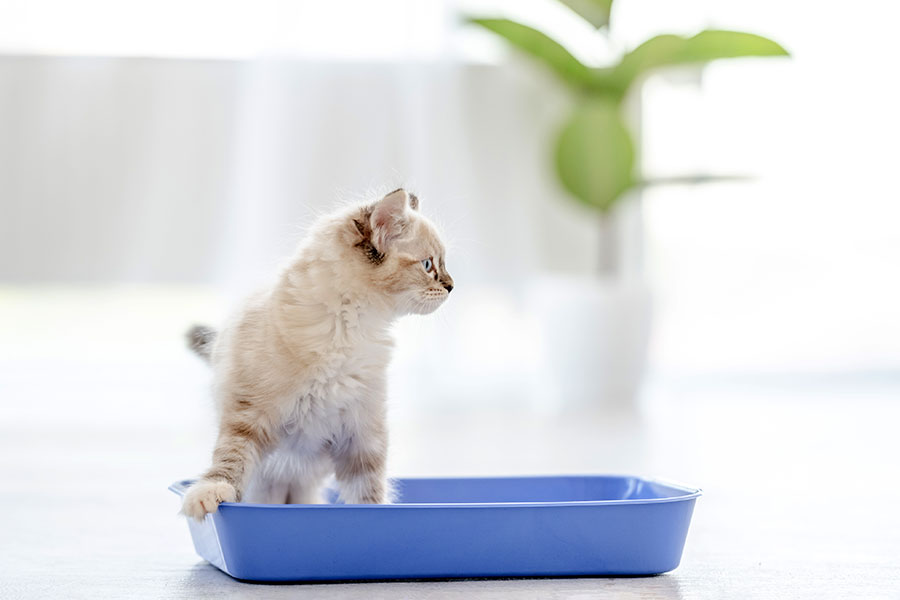
You know cats; they pretty much teach themselves where to go to the bathroom. Put down a litter box and they will find it and use it. It is a good idea to show them where you have located it in the first place, but generally cats want to use their litter box to do their business.
THE WHY
So what does it mean when your litter boxed trained cat starts looking for other places to relieve himself inside your home? There could be several causes to look into. Let’s start by saying that even the best trained kitty may accidentally relieve himself outside the litterbox from time to time. Sometimes his aim may just be a little off. But, if this becomes the new norm at your home, the first thing to do is get that little furball to the vet. There can be physical reasons why your kitty may not want to potty in their box. I’ve had, unfortunately, a lot of experience with FUS (Feline Urological Syndrome) in my male cats. That is where their body starts to develop sharp crystals in their urine while it is still in the bladder. These crystals irritate the lining of the cat’s lower urinary tract, thus leading to a blockage of urine flow from their urethra. If left unchecked this can lead to major health problems, including death in male cats.
This problem can be genetic, but it can also be caused or exacerbated by the food you are feeding your cat. Image how painful that must be, and the kitty associates the pain of trying to go potty with the litter box, and therefore finds an alternate place to relieve himself away from the box. Your veterinary will be able to diagnose and treat this problem. That’s why your first step in diagnosing what’s going on with your once perfect litter box using cat, is to make an appointment with their veterinarian. If your kitty checks out fine physically, the next step involves cat psychology.
OTHER LITTER BOX ISSUES MAY BE PSYCHOLOGICAL IN NATURE
A change in their routine can set them off in the wrong direction. The arrival of a new baby, with all the new smells and sounds, can trigger undesirable litter box habits. The same is true with the arrival of another pet in the house – a dog, another cat, even a pet bird can cause changes in your cat’s behavior. The absence of a family member can bring about issues as well: Maybe your child has moved out or gone off to college. All these things can trigger anxiety in your once well-trained cat. These changes in the household dynamic change the smells in the home as well, and cats are very sensitive to scent. Personal experience again – when I was volunteering with a cat rescue group, my cat Dexter didn’t like the smells I was bringing home on my cloths. I wasn’t aware of this until I made the mistake of putting the clothes I had worn at the rescue on the floor in the laundry room and later found that sweet little Dexter had relieved himself on the entire pile of clothes. Thank you very much Dexter! I’ve also heard of kitties eliminating on the items left behind by the person who has moved out. Since cats are very scent driven, they are leaving their “scent” so that the missing person can find their way back home.
PAINFUL LITTER
Another reason your cat may be having litter box accidents is because some cats have very sensitive paws and may not like the texture of the litter that is in their box. Be aware that if your cat suddenly starts eliminating right outside their box, it is possible that they don’t want to touch the painful litter. I’ve even seen a cat try to balance on the rim of the box to eliminate, just to avoid putting their sensitive paws on the litter. There are so many formulations of litter, from recycled newspaper, pulverized walnut shells, clumping, clay, scented and unscented, time-release, multi-cat; take some time to see what kind your kitty prefers and stick with it. Don’t be tempted by the bargain litter or the one you have a coupon for. You’ll be happy if your kitty is happy.
Speaking of the litter, make sure the litter box you have selected for your cat(s) is appropriate for them. Please don’t make a senior cat jump up into a box with high side walls and then fall into the litter box. It’s not pretty, nor is it humane. Get them a box with low sides so they can easily maneuver into and out of the box. Some cats like privacy and therefore they should have a box with a lid and maybe even a swinging door to gain access to their commode. Also, think about getting a second box, even if you only have one cat, especially if they are a senior cat – maybe they spend a lot of time upstairs and the lone litter box is all the way downstairs. Chances are they won’t make it to the potty on time, every time, so give them the option of convenience.
CLEAN IT UP
Of course, you need to keep those litterboxes clean. Scooping once a day is minimum. Some cats may prefer you change the litter entirely several times a week, although once a week is fine if it is okay with your cat. I once heard about a kitty that peed in its owner’s purse because their litter box was dirty. Yikes, let’s not have that happen to you!
If your kitty has begun soiling outside its box, please do yourself a big favor and spend some time cleaning those areas up properly. WARNING – so many household cleaners contain ammonia-this is the same chemical found in urine and stool, so look for a product that does not contain ammonia and do a thorough cleaning. You don’t want to encourage the continuing potty accidents by using a cleaner that actually smells like their urine, thus encouraging them to re-soil the wrong areas. Look for an odor neutralizing type product.
Hopefully these tips will help you should you encounter an “outside the box” problem with your kitty.
Remember, the first step is to have the kitty checked out by your veterinarian to ensure he’s healthy and happy.
0 Comments